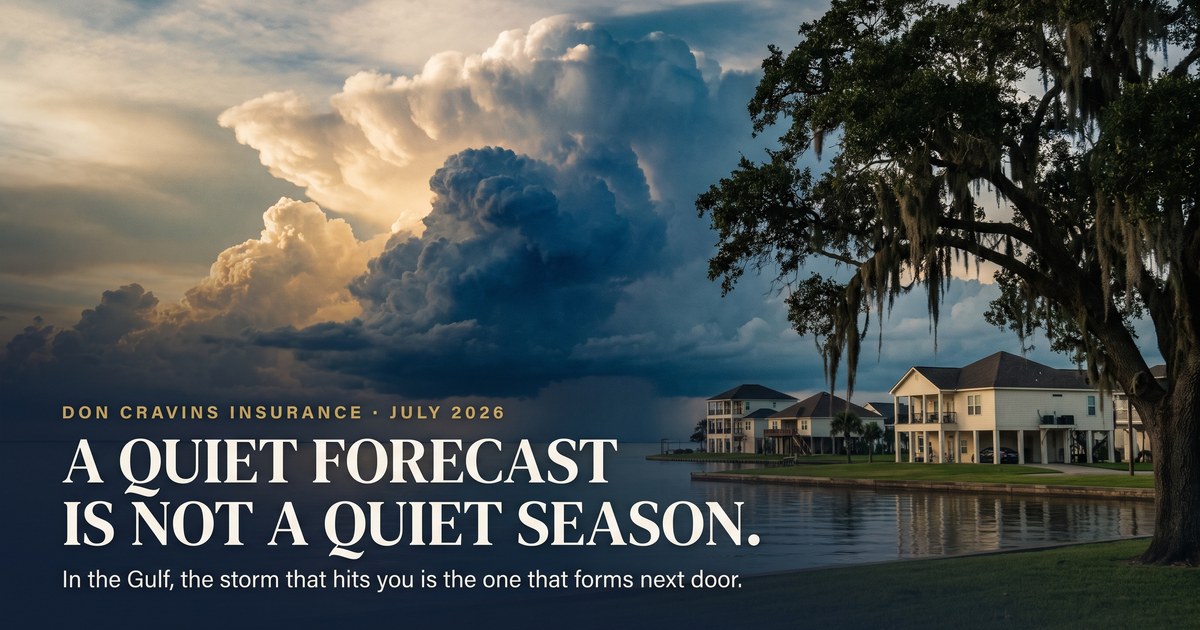
Every forecast this year says the same thing: fewer storms. NOAA called for a below-normal season. Colorado State cut its June numbers to eleven named storms and lowered the odds of a hurricane reaching the Gulf Coast to fourteen percent, down from twenty. El Niño is building in the Pacific, and El Niño usually means the Atlantic runs quiet.
Here is the part that does not make the headline. The state climatologist, Jay Grymes, ran the numbers a different way. Over the last twenty to twenty-five years, Louisiana has averaged one named-storm impact a year — El Niño, La Niña, or neither. The Pacific does not read the Louisiana map.
For southwest Louisiana, the quiet forecast is the dangerous part — because of how storms form in a year like this one.
The storm that forms next door
In a normal season, the storms that scare us are the long-trackers — the ones that roll off Africa and give the Gulf five, six, seven days of warning. You watch the cone tighten for a week. El Niño takes those away. The same wind shear that suppresses the count also shreds the long-distance systems before they arrive.
What it does not stop is the homegrown kind — a stalled front or a lazy disturbance that sits on bathtub-warm Gulf water off the Louisiana and Texas coast and organizes right there. Two days of warning. Sometimes less. It forms where you live.
Grymes put it plainly: in El Niño years, the ones to worry about are the homegrown varieties that pop up in the Gulf and give you three days, two days of heads-up. And of the last six or seven storms that hit the Gulf Coast region, most went through rapid intensification in under twenty-four hours. A tropical storm on Tuesday can be a Category 3 at landfall on Thursday.
Southwest Louisiana already knows this movie. In 2020, Laura came ashore near Lake Charles as a Category 4 and did nineteen billion dollars in damage. Six weeks later, Delta made landfall almost in the same spot. Neither gave the region a comfortable week to prepare.
History does not care about the count
Betsy hit Louisiana in 1965 — an El Niño year — as a Category 4 at Grand Isle, flooded New Orleans, and rewrote how the country builds levees. Andrew, 1992, was one of the slowest seasons in memory; it was also a Category 5 that tore across the state. The season can produce a handful of storms, and one of them can still be the one they name buildings after.
The number to remember, Grymes said, is not eleven or fourteen percent. It is zero or one: are you going to prepare, yes or no.
What southwest Louisiana should do while the Gulf is quiet
The good news is the market has a little more room in it than it did two renewals ago. Louisiana saw its first homeowners rate decreases in five years in 2025, and new carriers have been approved to write here. Use the quiet to shop and to check three things.
Your named-storm deductible is a percentage — usually 2 to 5 percent of your dwelling coverage, not of the damage. On a $300,000 home that is $6,000 to $15,000 out of pocket before the policy pays anything. Turn yours into a real dollar figure now, not after.
Flood is a separate policy, and it is not in your homeowners coverage. In Louisiana the water is usually what gets you, and the federal program makes you wait 30 days before it starts. A homegrown storm does not wait 30 days. If you do not carry flood, the decision has to happen before a system has a name.
Your dwelling limit has to rebuild the house at 2026 prices. Construction costs have moved. If your number still reflects the year you signed, a total loss can leave you underinsured while you never missed a payment.
None of this takes long. It is a 20-minute review with an agent who knows Louisiana roofs, Louisiana adjusters, and Louisiana storms. Donald Cravins Insurance Agency has been doing exactly that for Lafayette and Acadiana families for 45 years — independent, local, shopping multiple carriers to find the coverage that actually holds.
The forecast says quiet. Southwest Louisiana knows better. Review your policy now, while the Gulf still is. Call (337) 234-9834.